
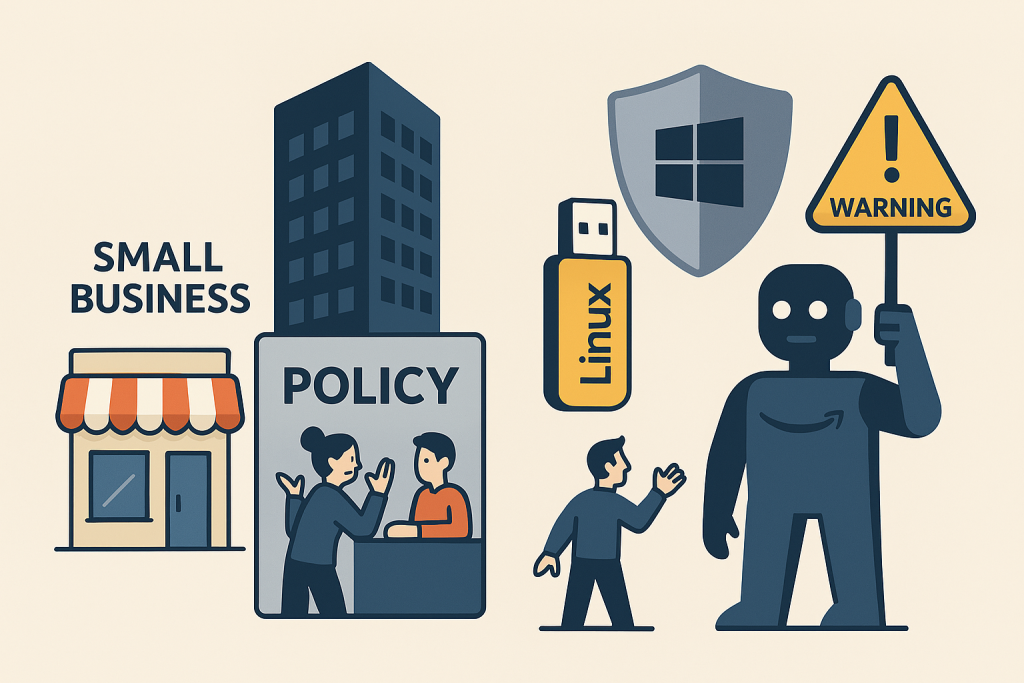
Running a small business should be simple: you sell a product, you support your customers, and you do your best to make sure they’re happy. That’s the whole point of being a small business — you can offer the kind of personal, human support that big corporations simply don’t have the time or interest to provide.
But lately, I’ve discovered something strange.
Helping customers — genuinely helping them — is starting to feel like breaking the rules.
And the reason isn’t the customers.
It’s the corporations we’re forced to work through.
The Amazon Paradox: Customers Want Help, Amazon Doesn’t Want You to Give It
I sell USB sticks preloaded with Linux distributions and other tools. Most customers plug them in and get going. A few need a little help — maybe their BIOS is set to UEFI, maybe Secure Boot is on, maybe they don’t know which key opens the boot menu. Nothing dramatic. A quick message with some simple instructions usually solves everything.
So I created a friendly, automated support message.
Customers loved it.
They thanked me.
They said it saved them time and frustration.
Amazon, however, did not love it.
According to Amazon, my helpful message was “review manipulation.”
Not because I asked for reviews — I didn’t.
Not because I offered incentives — I didn’t.
But because I encouraged customers to contact me if they had problems instead of assuming the product was faulty.
Apparently, that’s enough to trigger a warning.
Amazon’s automated system demanded that I explain:
- how I “manipulated reviews,”
- who helped me do it,
- which third‑party organisations were involved,
- and what steps I would take to stop my “prohibited activities.”
All because I sent a message saying:
“If you have any issues, feel free to contact me — I can usually help.”
This is the world small businesses now operate in.
A world where offering support is treated as suspicious.
Microsoft Isn’t Much Better: The ISO That Must Not Be Named
Then there’s Microsoft.
Customers often need a clean Windows installer.
They’ve lost their disc, their PC won’t boot, or they just want a fresh start.
You’d think Microsoft would make this easy.
Instead, they make it nearly impossible.
Try downloading a Windows ISO directly to a USB stick?
Blocked.
Try preparing installation media for a customer who already owns a licence?
Jump through hoops.
Try helping someone who just wants their computer to work again?
Good luck.
Microsoft’s systems are designed to prevent piracy — fair enough — but in the process, they make legitimate support harder for everyone.
Customers can create their own Windows Installation Sticks, that’s OK, but I am not allowed to do it for you, not even for free! Microsoft are missing a trick here!
Do they know how many customers have moved to Linux because of this and their stupid blocks on older PCs running Windows 11?
The Big Picture: Small Businesses Care, Big Corporations Protect Themselves
Here’s the irony:
- Customers want help.
- Small businesses want to help.
- Big corporations want to protect themselves.
And in that triangle, the customer experience suffers.
Small businesses are punished for being proactive.
Big corporations hide behind automated policies.
And customers are left wondering why nobody can just give them a straight answer.
Why Small Businesses Still Win
Despite all this, small businesses still have one huge advantage:
we actually care.
We don’t hide behind automated warnings.
We don’t treat customers like potential criminals.
We don’t design systems that assume the worst.
We help because we want to.
We help because we can.
We help because we know what it’s like to be on the other side of the screen, confused and frustrated, just wanting something to work.
Do we want to make money? Of course we do?
I charge for Linux Mint when you can get it for free, but I am sure you will agree that my charges are reasonable bearing in mind the cost of USBs, Postage etc . and I will answer any support email I can, sometime this involves research etc, as I don’t know everything!
Honestly, if I make £1 profit on these sticks, I am happy.
And no matter how many hoops Amazon or Microsoft put in front of us, that’s not going to change.
Final Thoughts
If you’re a small business owner, you’ve probably felt this too — the constant tension between wanting to support your customers and navigating the policies of the platforms you rely on.
If you’re a customer, just know this:
Behind every small business is a real person trying their best to help you, even when the big corporations make it harder than it needs to be.
And if you work at Amazon or Microsoft…
maybe take a moment to remember that not everyone is trying to game the system.
Some of us are just trying to help…